Interview with EoSD New Classic Translators (Part 2 of 3)

A continuation of our interview with the various translators of the New Classic version of EoSD.

Now that we’ve allowed the readers to familiarize themselves with you, let’s move on to questions regarding the remake and the translation.
Questions about the EoSD New Classic Translation
Q : What’s your opinion on the EoSD remake, as well as the choice to localize it into your language?
brliron: Finally a version of the game that works on Windows out of the box! I’ve seen so many people asking for help with getting EoSD to work on their computer… I don’t think I’m exaggerating by saying I’ve seen at least 100 of them.
Anyway, I would have never guessed that we would ever get an officially endorsed French translation (I know it’s still not official, but it still feels a lot more official than when you need to download a 3rd party tool). An English or Chinese one seemed very unlikely but still possible, but I didn’t expect anything else. But I love that they chose to make one, and I love that they chose to involve the international community in order to get the highest quality translation they could – hopefully the players will agree with this statement instead of saying that our translations suck. 😅
Aridow: As I said, I’m very happy to have a modernized version of the game with a better playability and a new mode. It’s great to finally have an official French translation of a Touhou game.
Alfa: Despite how iconic it is, I think the original game aged badly compared to even just the next two games (PCB and IN), and a coat of fresh paint helps. It’s something that it also deserves given its popularity. I am quite happy about it being localized in Italian for partly obvious reasons, but also because when I got into Touhou there wasn’t a single active italian community. I’ve witnessed it slowly rise from the ashes and change form multiple times, and I’m very satisfied with its current incarnation. I’d like to think that this has only happened thanks to everyone’s efforts.
Janik: Besides being very happy that our efforts as translators are officially recognized in Italian (and that you don’t have to jump through crazy hoops to patch the game), the remake seems to be a great adaptation and a very effective way to introduce new fans to the series.
Splashman: EoSD with its outdated Windows 98 engine has become a bit of a hassle to run properly on modern systems, so it’s nice that the new fans finally get a chance to play it properly. The long list of available languages is an absolute first for Touhou games and I’m honored that I could offer my part.
Nuss: I like that we’re able to ship it out with our German translation. Sure people would probably play it in english, since that is how it’s going for many games these days, but I’m always glad to see someone take their time to make a good German translation and I am glad EoSD NC is getting one!
KDOXG: Well, it’s about time! Every single day you could find new fans getting interested for the first time in the games. Although we have the Touhou Community Patch for more than a decade, the distribution and communication are not that easy for newbies in retro doujin games. A lot of people get frustrated dealing with the older games, so having this new release is truly a blessing for increasing the accessibility of these games. Now I can recommend EoSD to others without feeling guilty!
And when I was contacted to work on an official translation to Brazilian Portuguese, oh boy, what an emotion! It was a great surprise to see my country getting recognized to the point of our language being included. We Brazilians are very spread out in the Touhou community online, so it’s a real satisfaction to see the directors realize our fanbase deserves being represented in this project.
Paleta: I think it is a really welcome remake. Although a good game, EoSD kinda aged. There’s no easy way to get it officially, getting translation and bug fix patches need external tools, it lacks some basic QoL features that were added on future games, its resolution is low compared to current standards and it has compatibility problems with modern systems. The remake did a great job fixing all of these problems, and it is basically the ultimate EoSD experience. Even things that were already pretty good, like the songs, only got even better! The choice of localization really shows that they care about the community, and it’s a big win both for the game and the fans.
Raf: I think the idea of remaking EoSD would already be a good idea, since it wasn’t on Steam and it’s very hard to get access to the original game. But the fact that they decided to include translations made me very, very surprised and happy. I never imagined that Touhou would have an official portuguese localization! This also applies to the other languages. I think that the fact that the remake is as faithful as possible to the original game, including an exact copy of the original EoSD, is a very good quality too.
ACE: I think it’s fantastic! It’s a really good way to make new people know it and understand it in their respective language, an ultimate experience backed-up by ZUN himself! The new visuals, updated design and more accessibility really makes for preserving this new classic. And it’s very important for Brazil and other communities like Italy and Latin America, because we now feel even more seen! This remake was a very nice surprise and I feel grateful for translating it!
Orphen: I’m very happy about the news. I don’t think many fans expected Touhou 6 to return in this way, so I’m really glad they decided to give another opportunity to a game that is so important to the history of the series.
I’m especially excited that it will receive an official localization into our language. Not only will this allow more Latin American Spanish-speaking fans to enjoy the game, but it also represents an important step toward bringing Touhou to a wider audience.
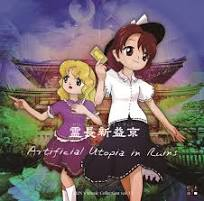
Chise: It means a lot to see this happen to the game that got me into Touhou Project. The new artwork and music arrangements are also fantastic. If you think about it, we’ve been blessed with great music this year, thanks to this release and Artificial Utopia in Ruins.
I think the decision to localize the game into ES-LA is a great one. There’s a huge number of fans and creators within the Latin American Spanish community.
Mizuchi: Returning to one’s roots, ironically, can be quite refreshing. I’m sure ZUN felt that way too. I personally see it as a brilliant move to introduce this work, which has so greatly influenced other projects, to both new generations and audiences worldwide. Latin American Spanish is spoken by a large part of the American continent, I am quite happy that they can all enjoy the game as well.
mugen: To be honest, I wasn’t expecting a remake of EoSD. This was a big surprise. It’s great we get to play the classic with high-resolution graphics and rearranged music (I’m really curious about the latter). Also, I’m happy that ZUN decided to make it available in so many languages, including Spanish. Who wouldn’t love that? It’s not every day you see your favorite indie developer have their game officially localized into your language.
Levander: I would have LIKED to translate the game into MY language (Finnish), but they wouldn’t let me. Sad!
Chlorine: Since EoSD is such a popular title, I think a remake that makes it more accessible is a very positive thing. On top of that, being able to enjoy an official Touhou Project game in my own language feels like a dream come true.
Ibisa: Quite literally, I think it’s wonderful to see something old being remade anew. And especially in this age of globalization, having support for multiple languages makes it feel like Touhou is reaching out to the world. I think that’s really great.
Lemington: When I heard about Russian translation for the first time, I immediately got up from my chair and did a little stupid dance. Then I thought “Well, of course there will be a Russian option, about time the third most popular language on Steam got some respect”. Regardless, working for ZUN officially was my dream for a long time so I am overjoyed and hopeful for the future releases.
Q : How did you feel about becoming involved in the localization of EoSD New Classic?
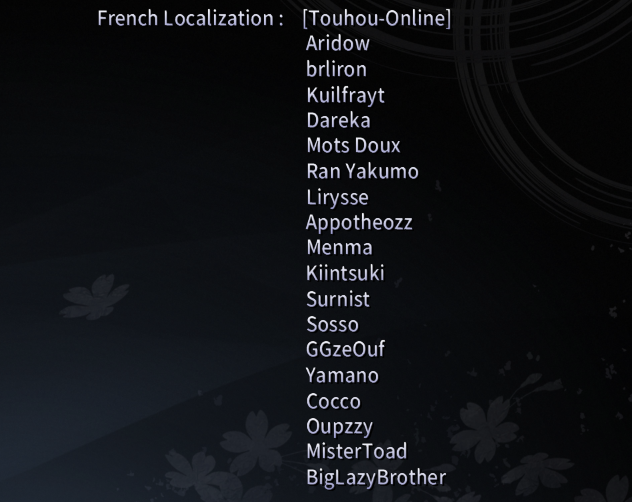
brliron: After all these years working on Touhou translation projects, I feel very proud to be part of an officially endorsed one. But for a while, I also felt like I maybe shouldn’t have been there? I do have some useful skills in proofreading, rewording, spellchecking, research etc (at least I think so), but I lack the most important one: being able to read Japanese. There’s a reason there are so many names in the French section of the credits, I didn’t translate this, these guys did most of the work, and me and Aridow just did another pass to try to make their good work even better (and the new texts like the music room and the achievements). Anyway, at this point I think I helped enough to deserve being mentioned alongside them in the credits.
Aridow: I was very glad that brliron asked me to take part in that adventure.
Alfa: Admittedly both an honour and a burden. An honour because my translation efforts have been recognized, and getting to work on in an official manner on something that I’ve been following for years. A burden because I would have to deliver something at a high enough quality that satisfied my own standards.
Janik: I’ll be honest, I’m extremely happy. The thought of seeing a game like Touhou in Italian makes me feel genuinely satisfied with what we’ve accomplished. On top of that, coming back to a great classic like this was a lot of fun, both playing it again and translating it.
Splashman: It came out of the blue and everybody who’s been in the fandom this long knows that it goes against any common patterns we know about ZUN (lol). I just got invited to the Discord server one day by my old friend brliron and when I saw the spreadsheet, my brain went “Oh, huh… they’re doing a EoSD remake and the whole thpatch family is invited to translate”, as if it was daily routine news. It took me a few days to fully register.
Nuss: I was excited when Splash asked me to help! I’m always happy to help!
KDOXG: When I was contacted by the director to work on this project, my first reaction was, “Is this some kind of scam?” The whole quick dynamic, the “doujin spirit” vibe that we all translators went through, it really sounded unpretentious — perhaps too much, to the point I was somewhat skeptical. Now, I’m not talking bad about the recruitment process, especially how it was intended to accelerate things and allow us keeping communication with the community as a whole in the best way possible, but… yeah, it really took me a while to sink in.
ZUN officially remaking one of his old games? It was completely unprecedented. Of course we can’t take his old interviews by heart, after all we don’t have to keep our word after 20 years or so. However, we fans are always speculating about ZUN’s opinion regarding these kinds of projects. Being involved in a legitimate effort like this is a testimony of our importance and proof that we, the active members of the Touhou fan community, can be trusted with such a relevant, pioneer project. I couldn’t be more proud of being part of this!
Paleta: It was pretty unusual for me, since I only became a part of the pt-br team after the remake was announced. At the time, it had only been a month since I entered Crônicas, so I was incredibly surprised when I was called to help with EoSD NC. I couldn’t be any happier, not only was I able to work officially for the game series that I love, but I also got to know better the amazing people that are the other members of the team (ACE, KDOXG and Raf). And I’m looking forward to working with them in more projects like this in the future.
Raf: It feels like a dream come true. This is the first really big translation project that I got into, and the biggest project I ever got the chance to work on in my life, it’s so surreal ^^’. To be honest, I don’t feel like I have enough experience or enough knowledge yet to be working on something like this, but with the help of my teammates we can do a very good job. And since I got this opportunity, I really tried to do my best and I put much love into this!
ACE: At first it was weird, because it was out of nowhere that the recruiter came to me. Then. I was extremely happy, ecstatic. Just the thought of it made me feel a million emotions, and made me translate it like my life depended on it, because THAT was the moment. And I couldn’t just let it go to waste, I PUT ALL MY ENERGY INTO IT. It was stressful, made me crack my skull. Yet I’m just as happy it came out to be. The community is just so happy about it!
Orphen: We’re very happy and honored to be part of the official localization of this game. After so many years of translating Touhou as fans, having the opportunity to officially participate in a project like this means a great deal to us.
We also feel that it serves as recognition of the effort that translation communities have dedicated to the series over the years. We greatly appreciate the initiative to include different languages and communities, and we’re very grateful to have been able to contribute our experience to the Latin American Spanish version.
Chise: Like the rest of the localization team, I’ve put a lot of effort and care into making sure EoSD’s charm remains intact for the players. It makes me very happy to be a part of it, and honestly I still find it surprising to this day.
Mizuchi: Honestly, it still feels surreal. I’m really happy to be a part of it, and I’ve put all my effort into making sure the result is one the players can enjoy.
mugen: Honestly, I never thought I would be part of something this amazing. When I started studying translation, one of my goals was to participate in the localization of a game from my favorite series, and now I think I can proudly say that I achieved it! And I would definitely do it again.
Levander: The recruitment process was basically a chain of people going “I know a guy”. I was excited, obviously. However, it also felt like a lot of responsibility. It was clear from the get-go that for better or worse, this official translation would be considered “definitive” and given a lot of weight, but also scrutinized for that reason. There was no objective answer to how we should take that, and we’d have to make our own decisions. The path of least resistance would’ve been to just follow the fan translations completely, but that would’ve been against the point of the whole exercise.
Chlorine: I remember thinking, “Can I really be given such an amazing opportunity?” That said, I had confidence in my translation skills, and since I love Touhou, I was more than happy to take part. Looking back on it, I still feel truly honored to have been given this opportunity.
Ibisa: It was amazing. I felt as though I had reached the very peak of what I could achieve, almost like I had accomplished one of the greatest milestones of my career. But I don’t want to become complacent here. I would like to keep moving forward and continue reaching new peaks throughout my career.
Lemington: Working on EoSD Remake allowed me to call up CyrusVorazan and UnKnwn: two amazing people that I’ve been working with a long time ago. Now, when the ol’ trio is back again the translation process is going smoothly and in great spirits.
Q : What was the most difficult part of the translation process? Were there any moments where you ended up struggling to figure out how to handle a specific line of dialogue or a scene?
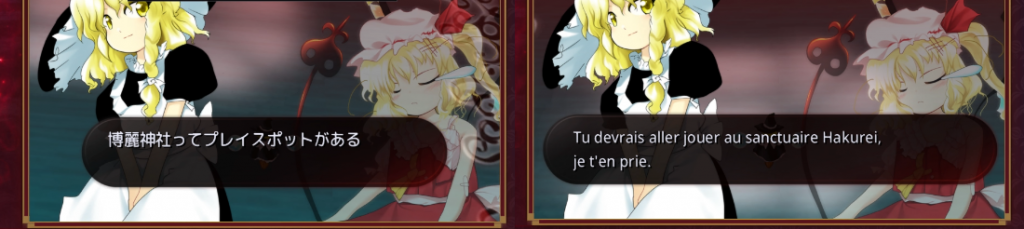
brliron: With most of the work already being done over the years before this project even started, we didn’t really have many difficulties. But there was one line that was especially hard to translate: “博麗神社ってプレイスポットがある“. There’s a wordplay with “play” and “pray” sounding quite similar (and we had explicit instructions to try to keep this wordplay), and… Well, in French, they’re “jouer” and “prier”, they don’t sound the same at all, and it was hard to find something I was satisfied with.
Aridow: Most of my work was to review what was already translated years ago by our association, but there were a lot of untranslated puns or strange sentences translated from early English versions. Actually, the hardest part was not the translation itself but the technical constraints caused by the game, like the lack of space, how the difficulty records must begin with the difficulty name, or even all the parts that we were to leave in English… resulting in some unaesthetic choices.
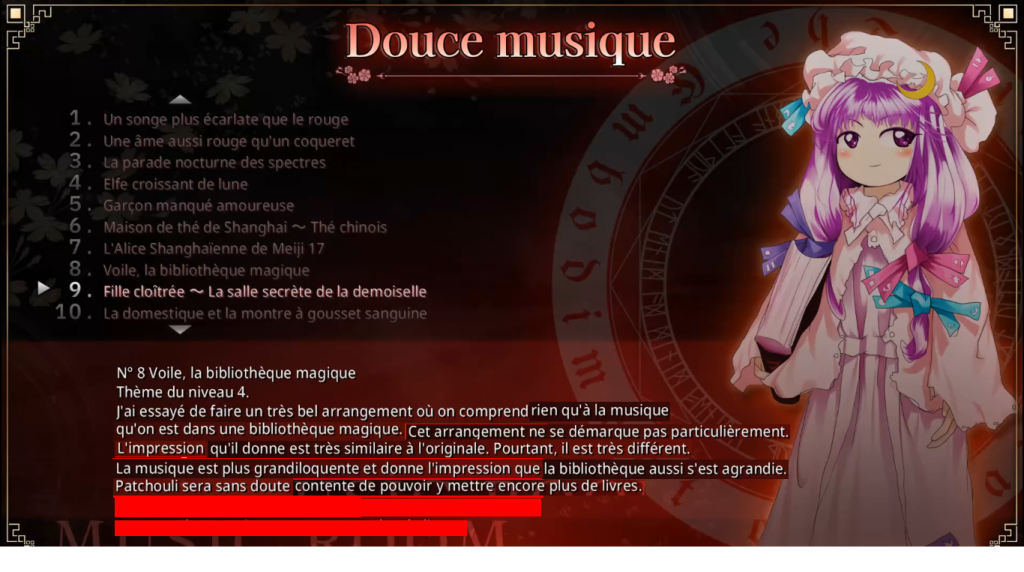
Alfa: Definitely the “New Classic” title, lol. Other than that, certain spells such as “Four of a Kind”, since the technical term is just “Poker” in italian.
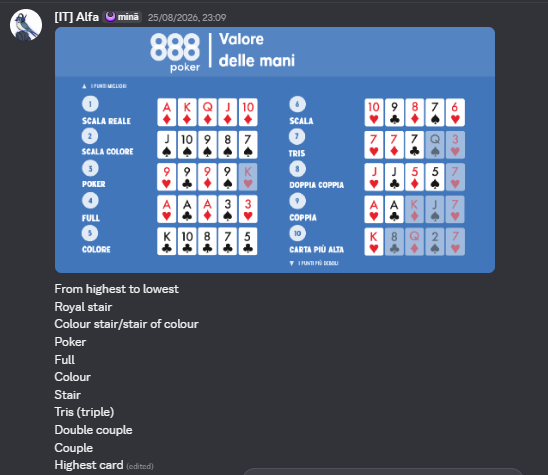
Janik: The issue with most Touhou adaptations is that Japanese is completely different, even in its puns, compared to Italian or even English. So quite often, you have to reinvent jokes or spell cards while trying to stay creative, faithful to the original, and above all, as non-cringe as possible. One example I recall is Stardust Reverie. With a bit of thinking, we adapted it to “Incanto Astrale” (Astral Enchantment).
Splashman: There weren’t that many difficult parts, since I had already finished the whole EoSD translation way back in 2016, which I was mostly satisfied with, so I could just copy it over in bulk. The other translators and I mostly struggled with the line length limits that were much shorter than the one used in thcrap, but we somehow managed to iron them out. It also gave me the opportunity to go over the whole dialogue once more for a few small rewrites and adjustments.
Nuss: I think the thing we struggled on might be text length. A few lines ended up spilling out of their box, but luckily enlarging the boxes themselves mostly fixed these problems.
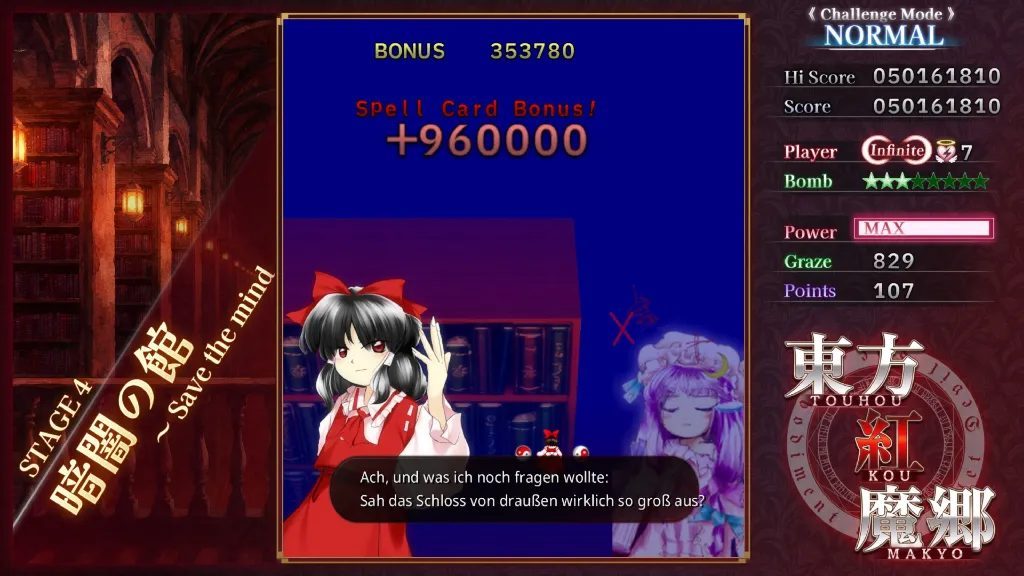
KDOXG: Without a single drop of doubt, the most difficult part to me was defining the character speech styles. From my experience, the most basic way to define how a character expresses itself is by applying how we imagine the character acting in certain scenes, in this case taking into consideration the raw contents of their dialogues. But the thing is, casually, I usually tend to not pay attention to character speech patterns in Japanese media. For this project, I had to study a ton of references so I could understand better how each character can be described by their speech style, and hopefully I could imagine them better and then apply it in my writing rules for consistency with my previous translations that were highly praised by the community. (Although it would be nice if those previous works could have been reviewed thoroughly by more PT-BR linguistics experts before starting this one…)
Yeah, I admit I suffer from a severe lack of expertise in dealing with moe characters. Maybe it’s because I’m mostly an “anime was a mistake” guy; my personal references are basically 70% other games, 30% all the kinds of shows I used to watch as a kid, most of them being Western cartoons and movies. I wonder how contradictory that is, considering the fact that moe is huge in most doujin games and I play those a lot… Well, at least most of the games I play are Japanese, so that may count for something~
Paleta: Well, there were definitely some puns and word plays that we had to rack our brains to adapt, and we still are kinda unsure if we took the best approach on adapting the mannerisms of speech from each character. But definitely the actual hardest part was making a localization that pleased most people. Since our translation was made public on Crônicas, we got a LOT of feedback and criticism.
I understand that the expectation for an official Touhou translation is really high, and everyone just wanted it to be the best possible, since in such a small community like ours, this project is setting THE standard for Brazilian Touhou translation. Unfortunately, that put a lot of pressure on the team, and it even was the reason I was called: to help handle the feedback. And even after analyzing all the thousands of messages (currently 11500!), there are still people that will be unhappy with some of our choices.
Raf: The fact is, we had to translate the game almost from scratch, since the previous attempts were incomplete or had many errors. The problem is that the time was low, and many important decisions for the future translations had to be made. But the hardest part was probably translating the spell cards. There are just so many of them, and they are one of the most important parts of the translation, so it has to be done with a lot of care. Even before EoSDNC we already discussed a lot about the translation of specific spell cards and general rules for spell card translation, so that’s what I’d say was our biggest struggle.
ACE: Oh, FOR SURE it was some jokes and very underground references. Like in Sakuya talking about Edict of Compassion for Living Beings, that it just worked in japanese. Oh, the Rumia looking like the kanji 十, we turned it into her looking like a kite, and basically all of Remilia’s speech was very confusing, but eventually we made it out and it just reads fluidly! More so, it was more difficult to come to a consensus on some songs’ and spells’ names, because they didn’t sound good or weren’t as smooth as English ones, such as Four of a Kind and Master Spark (yeah we translated those ones!)
Orphen: Adapting wordplay was one of the biggest challenges of the translation. Many times, simply translating a sentence literally isn’t enough. You need to find an alternative that preserves its intention, humor, and original meaning while also sounding natural in our language.
Although it wasn’t an easy task, we managed to find solutions that we were satisfied with. It was also one of the most enjoyable parts of the process, as it pushed us to be creative and reminded us that, even after years of translating, there is always something new to learn.
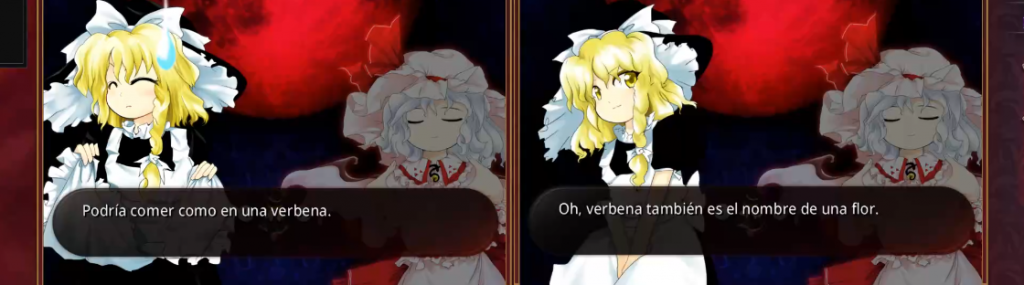
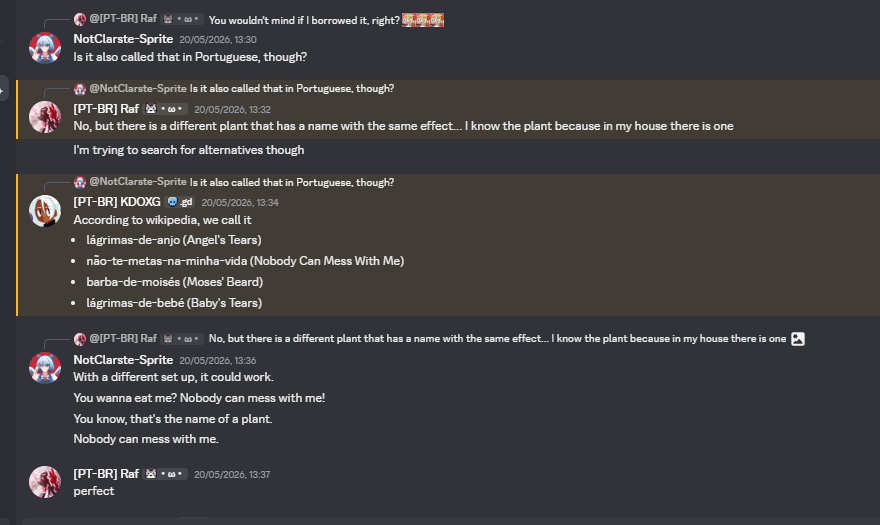
Marisa: Well, I’m so hungry I could eat as much as a Verbena (festival)
Marisa: You know, Verbena is also the name of a flower (Vervain flower)
Chise: Definitely wordplay! It’s quite common in Touhou Project. You can come up with a good adaptation right after you encounter it, or it may need to simmer in the back of your mind until a good idea comes. It’s a lot of fun, but it can change how much translation time you spend on a given day.
Mizuchi: The wordplays. It definitely had to be the wordplays. Many jokes work cleverly because of the language they’re written in. Direct translations ruin the message, and the adaptations we had to make in those cases had to maintain the original message and intent. It was a big challenge, but the result was quite good.
mugen: I’m still learning Japanese, so there would be times I came across some puns or wordplay that made me want to throw my laptop out the window. But sometimes I think I would still feel the same if I was more proficient (lol). Still, I think this makes a great way to put the things I already know to the test.
Levander: The game doesn’t actually have all that much text, in terms of sheer volume. Unsurprisingly, the most work hours definitely went into the wordplay and puns that EoSD is notorious for, where just a few lines could be mulled over for days until finally settling on the least bad option. However, the most stressful parts that I’ll probably remember for a long time had more to do with “policy” towards the established fan translations.
What old translations were too established to change despite being a bit off, or conversely too wrong to accept despite being well-known? When could we change something that wasn’t “wrong” per se just because we came up with something “better”? Given that our choices would be kinda set in stone, was it more important to not rock the boat or to take this “last chance” to change things? Stuff like that. It got easier once we got over some of the biggest questions, but we had to accept that people would keep relitigating them long after the game came out. And not without reason.
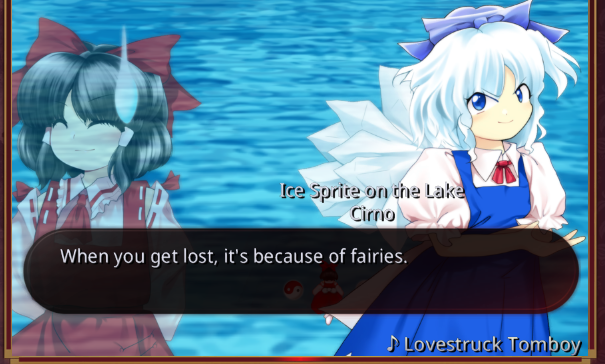
Chlorine: I’d say the most difficult parts were things related to cultural references or words that exist in Japan but not in Korea, as well as wordplay that only works in Japanese. I often found myself wondering how I could preserve the original creator’s intent and keep it fun, while making sure it felt natural in Korean. There were quite a few parts of this project that gave me a hard time as well, but I’m glad that I ended up being satisfied with the final result.
Ibisa: I wanted to preserve the atmosphere and nuances of the well-known existing unofficial translations while also improving the translation without compromising the original work. It was more about trying to make the translation better while still retaining what people were already familiar with.
Whenever I encountered particularly difficult challenges during the translation-such as wordplay, Mr. Chlorine-who worked alongside me on the project, would often suggest great ways to approach them, which was a huge help and gave me a lot of relief.
Lemington: Toughest thing would be not even the process itself, but long (and sometimes heated) discussions in preparation for it. Considering we used a lot of old ThPatch translations (some even 15 years old!) we ought to have a strong “Tradition vs Correctness” argument regarding some fan-accepted terms and expressions.
One of the biggest examples would be “Do we translate the word “Lunatic” or not?” You see, in Russian it only means “sleepwalker” and “denizen of the moon”, no madness connotations so the correct way would be to translate it, but the fandom has been using transliterated “лунатик” for almost two decades. In the end we decided to translate it, ending the argument we’ve had back and forth for a good couple of years. Usually though translating is really not that problematic, since Cyrus has JLPT-1, I have JLPT-4 and we all have experience in being literary editors.
Q : Conversely, what was your favourite part of the translation process? Was there a specific experience in the process that made you glad to be a part of it?
brliron: I was the 2nd western person to ever hear about this project after IceFairy, and my 1st task, before actually working on the French translation, was to recommend people for all the other languages. And it’s been very fun to gather all these people I’ve met over the years, with a mix of old hags who’ve been in this Touhou thing for as long as I did and other people I’ve met more recently, and get us all together to work on that project.

Aridow: I got to meet the people behind the other translation teams. Talking to them was always very interesting, especially as a language-enthusiast.
Alfa: Coming up with puns! It’s very satisfying to come up with a dialogue sequence that I like after half an hour of brainstorming. Some of the spellcard names also fit into this, for example the aforementioned “Poker d’Essi” (Assi = Aces, Essi = Selves. Flandre splits into 4 copies, so…)
Janik: Testing the dialogue and experiencing the translations directly in-game is one of the most fun parts. Rereading dialogue right inside the game helps you spot issues with how natural it sounds. Another example is when we need to find a different name for the spell cards. That’s where we can unleash our imagination a bit and find the most fitting name together with the rest of the team.
Splashman: My favorite part is imagining the voices of the characters in my head while translating them. I take great care in making every line sound unique, easy to read and quotable, while also staying accurate and true to the original text as closely as possible. My secret sauce is that I try to capture the style of my favorite German dubbing directors and voice actors from the 70s-90s, such as Arne Elsholtz and Thomas Danneberg, as well as early 2000s manga translations by Carlsen Comics and Egmont Manga. I especially like to channel Sandra Schwittau’s Bart Simpson voice when I translate Marisa.
Nuss: Like I said, I’m happy to be involved, even if it was just proofreading ^^
KDOXG: Now pinpointing anything somewhat specific on this would be kinda hard… Actually, I can say my favorite part of the translation process certainly was the research! I really don’t want to mention too much about the past contributions of the PT-BR translation community, but long story short: under my leadership over the past several months, the main objective of Crônicas de Gensokyo as a translation group was translating from scratch all the official materials from Japanese directly to Portuguese, conveying what the terms and expressions originally mean and adapt them to equivalent ones from our vocabulary, aiming for the general Brazilian public as our goal. (In other words, localization!)
To do that, we had to research a lot: reading lots of official texts to understand the entire context and ZUN’s mind goal, checking several dictionaries for how we can interpret the words, going after references of other relevant works with official established translations aiming for recognition from the public, and then, at last but not least, the time for debating with other fans and groups. (Not really different from what I was already doing for my fan game project!) This whole step is a huge part of our quality criteria and also one of the most time-consuming, but the more effort we put into the research, the more proud we end up being with our work.
Paleta: Seeing the translation finished and up and running on the game feels so rewarding. It is finally reaping the product of all the hard work you’ve been doing. And I always feel that the more effort I put into something, the more satisfying it is to see it done, especially if it’s done well. That feeling is what makes me participate in these kinds of projects and give my all in the first place.
Raf: I don’t think any part of the translation was easy. Translating from Japanese is hard! XD. Spell cards were very fun to translate, even if it was hard, but my favorite part is always the dialogues. It’s fun to adapt the way characters speak and adapt the jokes. The process of deciphering what the characters are trying to say is very fun too.
ACE: Oh, my favorite part by far was discussing back to back with my partners. You see, ALL THE TIME we were researching and discussing what we did, what we reviewed, and for the first time I felt like I was in a room with people that shared my passion. It was very professional and passionate, in a way that made me feel really into it. And for me, that was everything, including getting to know the translators of other languages! It was only kind of rough because of how our language was in need of polishing, so we had a lot of hard times, hehe.
Orphen: I’ve always believed that every project is an opportunity to learn and improve. This time, we also experienced something completely new by working alongside translation teams for many other languages.
Sharing experiences, challenges, and solutions with them was incredibly enriching and allowed us to discover new perspectives. We also had the opportunity to meet new people and make new friends throughout the process, and that international collaboration ultimately became my favorite part of the entire project.
Chise: Something special about this localization project was having mutual feedback between different language teams. There’s a lot to learn from them and everyone involved is very passionate about translation.
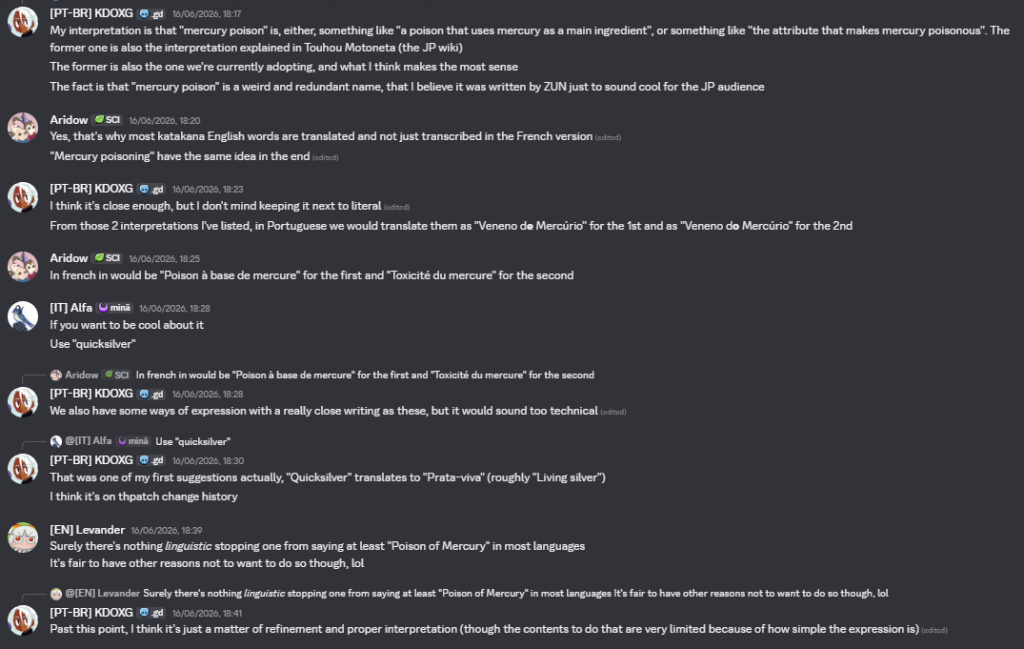
Mizuchi: Ironically, I’d also say it was the wordplays. It’s one of those cases where a surprising obstacle is thrown your way, and you have to find a way around it. We had to think and discuss… It was quite an intense creative process, but the result was totally worth it.
mugen: I really enjoyed researching terminology and looking for their possible equivalents in the target language. It can get difficult sometimes, but I could always count on my teammates to review the parts where I have been struggling and give me suggestions (they’ve been really helpful!). Just the fact that I’m working on an official localization of a beloved Touhou game was enough to make me glad to be a part of this project.
Levander: I’m used to translating solo and usually find long back-and-forths about translation choices pretty exhausting, but in this case, not only was it far better for the end result, it also made the process a lot more interesting and entertaining. The English translation would’ve been done way faster, but also way worse, if it was just e.g. one person staring feverishly at their own work until they deemed it good enough. Discussing things with the non-English translators was also a lot of fun.
Chlorine: Surprisingly, I actually enjoy the difficult parts, much like the ones I mentioned in question 7. Shooting games can be difficult too, but that’s part of what makes them fun, right? I suppose it’s pretty similar. I also enjoy working toward the best possible translation by bringing together Japanese and Korean dictionaries, online searches, my own knowledge, and the opinions of people around me. There’s no describing the sense of accomplishment I feel when, after all that deliberation, I finally arrive at a translation that I’m happy with.
Ibisa: Personally, I had the most fun translating the Music Room comments. Compared to ZUN’s comments from the past, I could feel that his thoughts and impressions had changed in some ways, and I really enjoyed being able to experience that aspect of the work myself.
Lemington: The feeling that I’m changing something, making a difference in a fandom and sometimes even guiding it would be the thing. I live a pretty unimportant life so doing something like this is freeing.
Interview with EoSD New Classic Translators (Part 2 of 3) End