Interview with Touhou M-1 Grand Prix Translation Team Part 2

Part 2 of the interview with the EN translators for Touhou M-1 Grand Prix
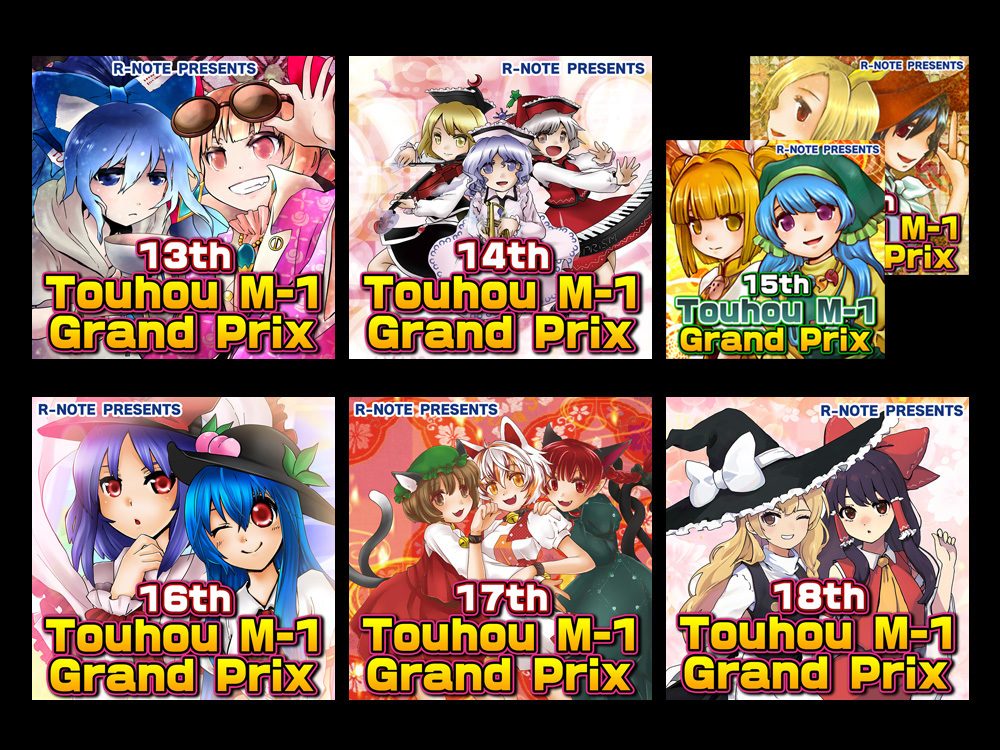

Part 2 of the 3-part Touhou M-1 Grand Prix special feature. This part covers recommended skits, as well as a watch/purchasing guide for the series.
Recommending Touhou M-1 Grand Prix
Q : There have been 19 Touhou Grand Prix and several extras over the years, which are your favourites? Which ones would you recommend to people familiar with the series? Which ones would you recommend to newcomers?
Hou : After spending so much time watching, scrutinizing, and even studying every video in the series, I find that I tend to prefer the newer ones since they’re, well, newer to me. The older ones definitely have a nostalgic appeal to them, but the recent releases all have aspects that I greatly enjoy. EX5 is unique in that it features a single duo for the entire runtime and it has some of my favorite manzai in the series. 19 captures the personalities of UDoALG’s quicky characters phenomenally and they all have great chemistry with each other. In EX6, which released this past summer, the main hosts are uniquely comedic in a way not really seen in the series before. I enjoy seeing these kinds of new and refreshing aspects with each release, so my answer is generally “the recent ones.”
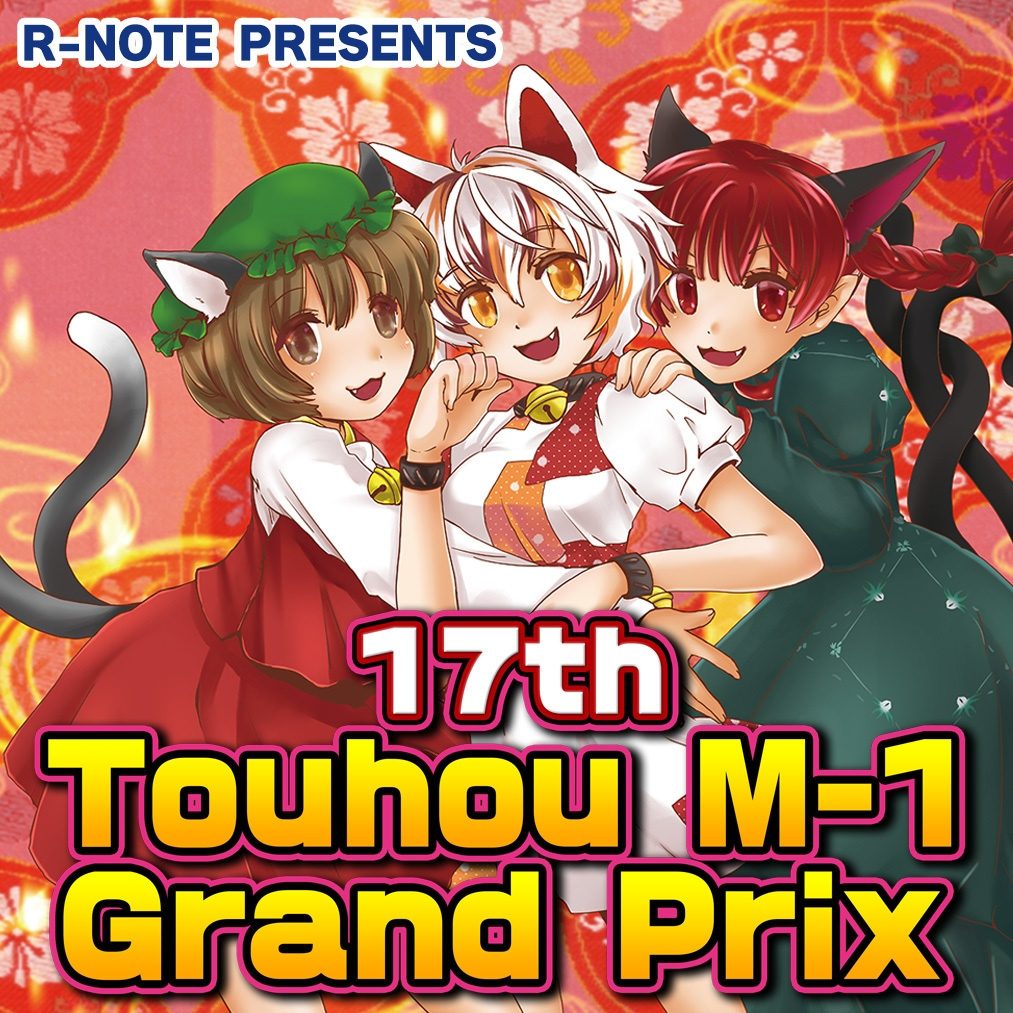
But if I had to pick just one, I think I would pick 17. It has a huge variety of manzai that feel very unique for the series and I never really feel like “Eh, I could maybe skip this part.” when rewatching it. If I feel like watching any manzai from 17, I would probably just rewatch the entire video rather than skipping to that manzai.
As for personal recommendations, then if you’re brand new to the series, I recommend watching the free clips on the Official R-NOTE YouTube channel. If you want to watch the full versions, then I highly encourage you to start from the beginning. The series is very self-referential and always evolving, so this will absolutely give you the most complete and rewarding experience.
But you can honestly have fun watching any of them without prior context. Some callbacks would fly over your head, but it’s usually not a big deal. When we screened 19 at TouhouFest, some of the people who watched it went in knowing basically nothing and they had a great time. There are also free broadcasts on YouTube a few times a year. Don’t miss those opportunities!
alonectorch : I had to spend hours on the phone with Hou and do further hours of data analysis to answer this question, so I hope my answer is satisfactory, haha… Anyway, my top three, in ascending order, are the 12th, 14th, and the 6th. For the 14th, I love it because I’m a big fan of Witch Doll (the Marisa and Alice team), and 14th has some of their best manzai. More importantly, though: OkiSha is in that one, and they’re inarguably one of the best duos in the series. I like 12th a bit more since it’s one of the title matches of Touhou M-1 Grand Prix. In that one, the winners of 7th through 11th all face off against one another and the current title holder. My second favorite manzai in the whole series is in that one. And I guess I’d have to say 6th is my all time favorite, since it’s the same concept as 12th, but for 1st through 5th, which are suuuper iconic. The peaks may be just about as high as 12th’s, but the rest is a bit better than the 12th. Which is saying something, since the 12th is awesome. .
If you’re already familiar with the series, I’d highly recommend checking out EX6, EX1 and 14! In EX6, two of the remade manzai are definite improvements over the original versions, which isn’t all that surprising since the originals were made over a decade ago. What you might not expect, though, is somehow they even managed to improve one of the best manzai in the history of Touhou M-1 Grand Prix! Moving on, if you haven’t seen EX1 yet, do yourself a favor and check it out. They turn the ‘owning a pet’ bit from 2nd R into its own manzai. More importantly, EX1 has the best version of the Spin Kappa convenience store manzai (Nitori’s expression at the cucumber is priceless), and has a really great twist on Unzan’s Pon de Ring manzai! I won’t spoil anything, but I’d say it even surpasses the original. And obviously, since I said 14th is my third favorite overall, I’d highly recommend it.
For newcomers to the series, I’d definitely recommend starting with the 3rd. Touhou M-1 is kind of a unique product, and it can be hard to know how to approach it if you’re not familiar. I mean this in the best way possible, but it is admittedly a bit of an acquired taste. It seems to me that it’s a lot easier to acquire that taste by starting as early as possible.
The only reason I don’t recommend starting with the 1st or 2nd is because they lack visuals. As for the third, which does have visuals, the production quality overall is a lot more endearing and plucky, which I think helps viewers let their guard down more and cut it more slack. That’s why I wouldn’t recommend starting with the 1st R or 2nd R (Remakes of the 1st and 2nd M-1 with visuals). Another reason I say start with 3rd is that in 3rd there’s a bit more of a focus on visual gags that aren’t reliant on the viewer being familiar with manzai. Because of all that, and like Hou said, the series being self-referential, I’d recommend starting with 3rd. If one starts there, they’ll probably have the best chances of enjoying the rest of the series to the fullest.
Hou : 1st R and 2nd R (the remakes) released around when the 7th and 8th Touhou M-1 were produced. What order would you recommend watching them in?
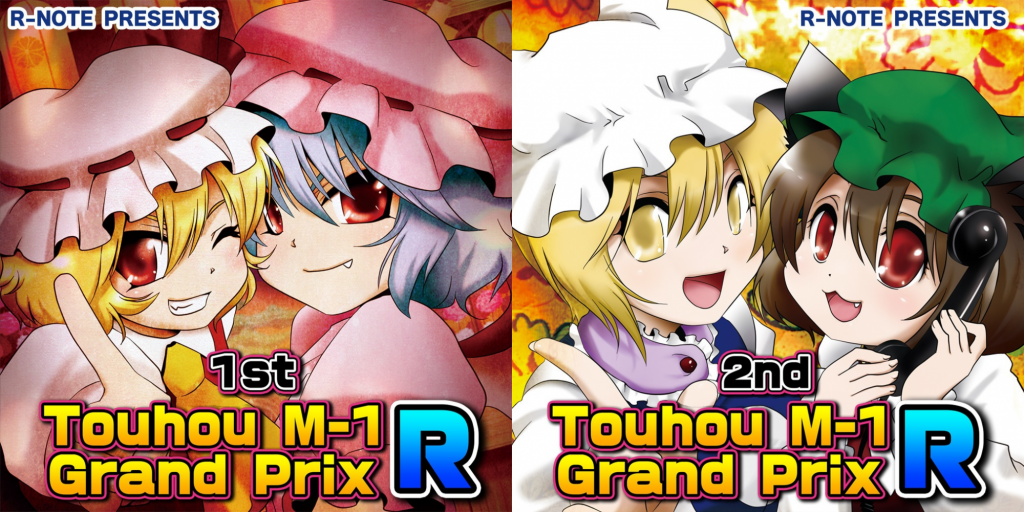
alonectorch : It depends on what kind of person you are. I would really recommend watching the remakes in release order if you’re okay with it. R-note made them with people who’ve seen the preexisting M-1’s in-mind. Stuff from 4th and 5th, for example, is even referenced in the dialogue of 2nd R. You’ll have the intended experience if you watch 1st and 2nd R in release order. The release order can easily be found at the Touhou Wiki page for Touhou M-1 Grand Prix.
If you’re a chronological order purist, though, I’d recommend going straight from 3rd to 1st R and going in chronological order from there. The switch from a rough production quality to a much more professional one and back might be a little jarring, but if you’re totally unfamiliar with Touhou M-1 there’s no better starting point than 3rd. Watching one full Touhou M-1 should give an average viewer enough context to enjoy 1st R well enough, so at that point I think it’s fine to go on to chronological order. I still think release order is the better option overall, though.
Hou : I actually disagree quite strongly, but I think I should clarify what we’re talking about because it’s a bit confusing. Originally at the very beginning, Touhou M-1 was an audio CD. It was from 3 onward that the series had an animator. Later on, R-note created animated remakes of the first two, called 1st and 2nd Touhou M-1 Grand Prix R respectively. Those basically serve as animated alternate versions of the originals. The actual release order for the series is 1-7, 1 R, 8, 2 R, 9, and then the series continues linearly.
With that context given, I still recommend that people start with 1R and 2R and then continue with the series chronologically. I think by skipping the first two, viewers will miss important establishing context for the series, since you’re effectively skipping two episodes of a TV show by doing that. The remakes are absolutely a viable alternative to the originals. There’s a continuous story that spans the first six releases, as well as a B-plot drama happening in the background. All of that is lost if you skip the first two, remake or not. So personally, I would still highly recommend starting from the beginning and just understanding that the first two remakes technically released later.
If at any point you want to go back and experience the original audio-only Touhou M-1 releases, the full tournaments are included with the 1st and 2nd remakes on DLsite and BOOTH and are fully English subbed.
Q : What is your singular favourite skit from the entirety of the series? What makes it your favourite?
Hou : See, I knew this question was coming and so I actually had to sit down and really think about it. But after sitting down and comparing all of them with each other, my answer is MikoKoro Household’s “Broadcasting Club” manzai from 9. I enjoy every aspect of that manzai from beginning to end. It’s well-paced; it subverts expectations very well; the voice acting is perfect for the characters; Miko and Kokoro both behave exactly how I’d imagine they would; it has a huge variety of jokes ranging from puns to irony to obscure references; and the sound effects add a perfect touch.
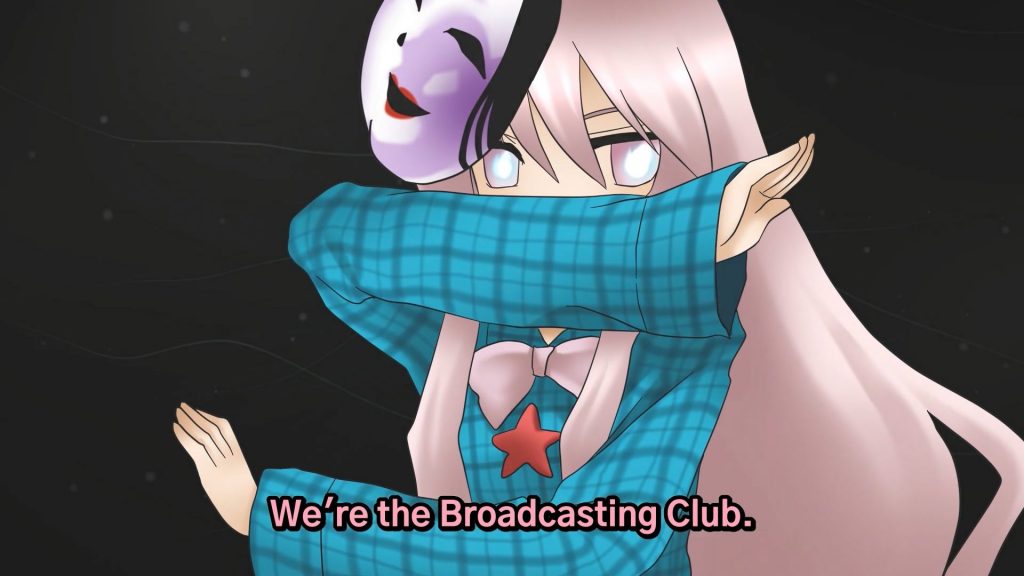
alonectorch : Really! Did I ever tell you that out of all the manzai I’ve ever had people perform live at my panel, that one seemed to get the most laughs and have the most consistent audience engagement? It seems to have some level of universal appeal. Any thoughts on that?
Hou : No, I had no idea! It has a lot of movement, so maybe that helps the audience stay engaged. You’re probably also giving good stage direction.
I’d also like to give an honorable mention to Star-Sparked Wildfox’s “Medical Operation” manzai from 17. While I slightly favor the Broadcasting Club manzai, the Medical Operation one has my favorite English subtitles in the entire series and I consider it to be the current gold standard for the translation of Touhou M-1. So as a fan of the series, my favorite is the Broadcasting Club manzai, but from a translator’s perspective, my answer is the Medical Operation one. Does that make sense?
-It does. I’m curious, what makes you consider Medical Operation to be the gold standard for the translation?
Hou : It’s a bit hard to explain because a lot of it is subtle. I think the subtitles manage to consistently deliver the meaning, feeling, and tone of every line for the entire duration. It flows well in English and no subtitle lines stick out as shoehorned or awkward to me. Jokes that have a language barrier to them are handled pretty naturally, puns get across, and I think the English subtitles pretty accurately convey the level of funniness or lack thereof with each line. Basically, I think it’s just as funny (or unfunny) as the original Japanese script.
alonectorch : I guess it’s my turn to answer this super hard to answer question, lol. I ended up doing one of those sorter things online to answer this question. Anyway, after thinking way too hard about it, I think Jealousy Star (Yuugi and Parsee)’s manzai ‘Youthful Days’ from 7th is my favorite in the whole series. By a surprisingly wide margin, now that I think about it. In general, I just, really love Jealousy Star’s dynamic throughout the whole series, so everything I go on to say about this particular manzai is on top of already having that huge bonus.
I love Jealousy Star’s dynamic to the point that even their weakest manzai is great, as far as I’m concerned. Yuugi’s constant, affable positivity and cheerfulness works really well when contrasted with someone who’s as much of a downer as Parsee. Parsee being characterized as a bit of a tsundere helps, too. Even their canonical personalities really suit a manzai duo, as well. Yuugi being the ‘boke’ who’s not really doing anything wrong, and Parsee the ‘tsukkomi’ who’s just being so harsh and unreasonable that she loops back around to being a ‘boke’ is so fitting. Yuugi just laughing it off, totally unaffected, when Parsee hits her or yells at her is just what I’d expect.
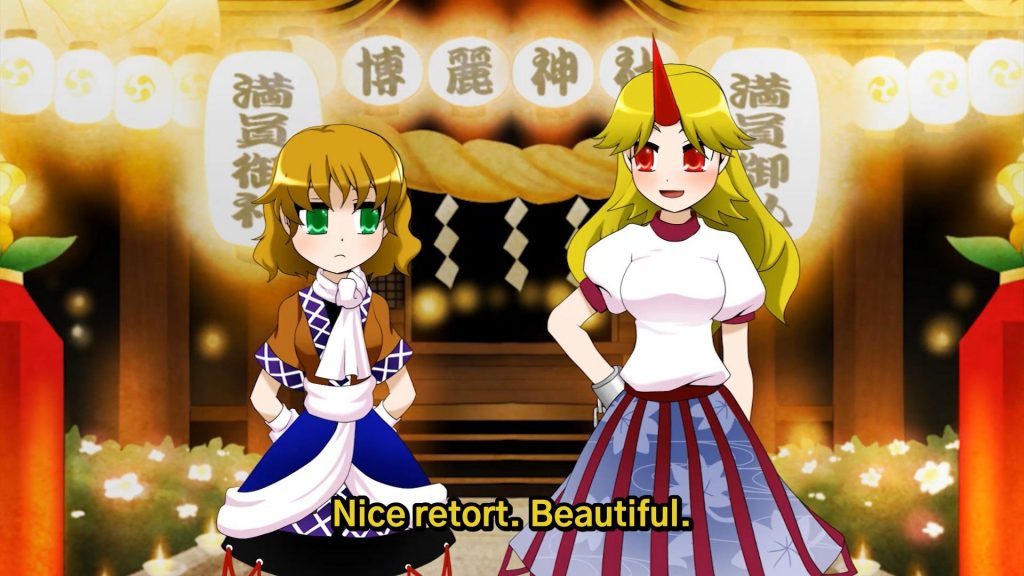
As for this particular manzai rather than their dynamic in general though? Well, for example, I love the way Parsee keeps cutting Yuugi off with her ‘’Preciate it.’s in the beginning. More than that, though, I love her crying (which is hilarious to me in its own right) before switching right back to her previous character. And if I said I didn’t enjoy Yuugi’s callback to ‘Little Yuu’, I’d be a liar, lol. I just think it’s a perfect manzai. Not a single line is wasted, and every single joke that was made lands with me.
Q : As translators, I’m sure a good part of your motivation for translating the series is so it can be enjoyed by a larger audience. Have you had any trouble with getting people interested in the series?
alonectorch : Of course it is. I love just getting to meet people who enjoy Touhou M-1. I could talk about it for days, no exaggeration (lol). Trying to get people interested in the series, though, has turned out to be an excellent exercise in learning how to handle rejection. Touhou M-1 Grand Prix is a lightly animated Touhou fan-work for people who also happen to be aware of manzai, a type of duo-stand-up comedy the likes of which has not been seen in English-speaking countries since Abbot and Costello in the 1940’s. It really ends up being one of those ‘if you get it, you get it’ things.
Finding English speakers who like Touhou and/or the boke-tsukkomi dynamic enough to enjoy Touhou M-1 is incredibly challenging. The only time I’ve ever had any luck with getting people interested in the series as a whole is by repeatedly showing my friends segments occasionally over a long period of time, lol. That’s a bad thing in that it can be incredibly difficult to get people to enjoy it, but it also means the people who ‘get it’ tend to take a liking to it rather quickly.
Hou : I’ve seen a fair number of English-speaking Touhou fans say that Touhou M-1 was their first introduction to manzai. I definitely agree that it can take a bit of time for the manzai format to fully click with those who are new to it.
The back-and-forth dynamic in a manzai is a bit like a beat drop in music. One character does or says something outrageous which adds tension, and then the other person retorts the absurdity in some grounded way, which releases that tension. But like music, it’s something that’s difficult to explain and just has to be felt.
To be entirely honest, the single biggest obstacle I feel like I currently face is informing people that the entire series is, not only available with full English subtitles (including the bonus content on DLsite), but still on-going. As far as I can tell, a lot of people have seen some out-of-context clips from the older releases and they seem to assume that that’s the extent of the series. But generally, most people who give the series a try seem to enjoy it, even if they have no idea what manzai is.
I don’t personally have a very wide reach and don’t use social media a lot, but I do try to make sure that new releases get announced in English. Things like English-translated announcements from R-note and even the trailers for the English releases are all done in hopes that more people can be informed about the series. But ultimately, people still have to find R-note’s YouTube channel and/or Twitter account to see those.
-Aside from social media, have you used any other method of introducing the series to a wider audience?
Hou : The main extent of what I do is trying to ensure that announcements of new releases get announced by R-note in English. Things like making sure YouTube broadcasts have their titles and descriptions translated is also important, as it’ll help things pop up in YouTube recommendations. I also made an English playlist with all of the official free clips. It’s gotten a surprising amount of views.YouTube also recently automatically applied auto-dubbing to a bunch of the Touhou M-1 videos and so I asked R-note to painstakingly go through them one-by-one and disable it on every video.
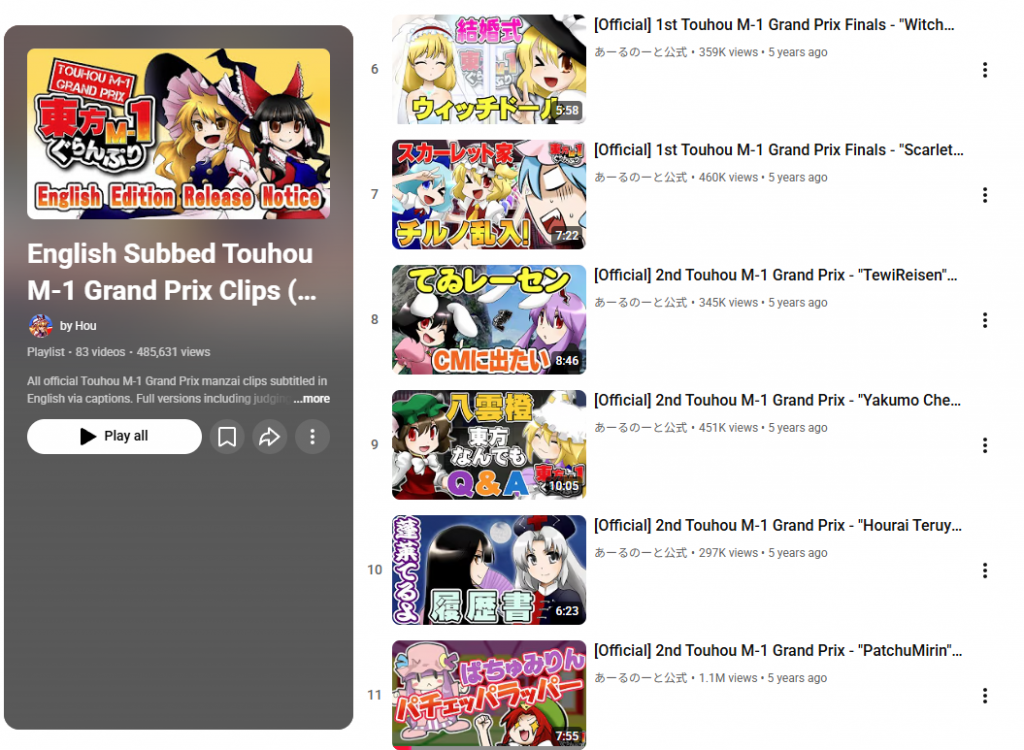
alonectorch : You made that playlist? I thought R-Note made it!
Hou : The reason I actually made it is because at the time, the videos didn’t have English titles, so they were really hard to find. I hoped that by making a playlist with an English title, people would be able to find the videos easier. It definitely paid off.
But to be honest, a lot of it relies on word-of-mouth information. For anyone who enjoys the series, please talk about it with people! It helps so much!
alonectorch : That quesiton might not have been entirely directed at me, but I have kind of a funny story about that. I run a regular event at a few conventions in the midwest United States where congoers are challenged to perform manzai from Touhou M-1 using nothing but the script projected in front of them and my stage directions.
-How does that usually work out? Some of the manzai in the series seem like they would be pretty difficult to perform live.
alonectorch : These days, the first thing I do is turn the projector around so that it’s projecting behind the audience. This is so that performers face the audience when reading their lines, rather than looking down at a script or behind them, where the projector is normally facing. A great bonus of this is that the audience cannot see what’s going to happen by reading what’s being projected. At that point, I just have performers do their best to act out the script, with myself giving Whose-Line-is-it-Anyway-style live stage directions for scene transitions and actions I need the performers to act out. The live stage directions seem to be pretty engaging for most audience members and performers, so the only manzai that end up being difficult to perform live are the ones that rely heavily on knowledge of Touhou.
I run this panel at general anime conventions, so most of my audience members and performers aren’t even Touhou fans. This normally isn’t a problem , since with most of the manzai, knowledge of Touhou is helpful but not necessary. With some of them though, I’m kind of just gritting my teeth up at the panelist table as all the touhou references completely bomb. Overall though, a great time does seem to be had by all. I have 8 different panels I regularly do, and this one generally has some of the best retention.
Closing Statements
Q : Thank you very much for taking the time to participate in this interview. Do you have any closing statements to say to our readers?
alonectorch: I could say so much here, but I’ll keep it concise. If you’ve ever given Touhou M-1 Grand Prix so much as one single view, thank you. Without the viewers, I wouldn’t have met some of my closest friends, including Houーthe internet friend I’ve spent more time with than any other―and the incredible IceFairy, who is just. He’s an amazing person, truly one of god’s own prototypes. Without the viewers, I wouldn’t have gotten to go to TouhouFest twice, as a panelist and an Exhibitor. I wouldn’t have had the pleasure of helping with the official physical English release. I wouldn’t be an official localizer in any capacity if it weren’t for you viewers. You’ve all, in some part, changed my life so much I can’t imagine how it would be otherwise. All of that stuff I mentioned is just the result of me being in the right place at the right time, but that wouldn’t have been possible without you watching in the first place. Words will never be enough, but thank you, from the bottom of my heart.
And thank you for taking the time to read this interview! I hope it enhances your viewing experience in the future, and that the responses were interesting. If you ever want to learn more, feel free to contact me. I could talk about this stuff all day.
Hou : I think there can be a bit of a language barrier between R-note and English speakers, so this may not always get across clearly, but R-note has been very happy to see the English side of Touhou M-1 grow. In producer commentaries and live streams, Ran-T, the producer, sometimes talks about the ways he expects or hopes English speakers will react to certain parts, bringing up English comments he’s seen. What started with R-note wanting to branch out and experiment has led to a full English release of the series, with new ones simultaneously releasing in Japanese and English. I think Touhou M-1 Grand Prix is truly a one-of-a-kind creation, both as a creative work and in the way its creators have fully embraced the English-speaking Touhou community.
At the end of the day, I’m just a fan who adores Touhou M-1 and wanted to help spread it to English speakers. I never could’ve imagined that the English side of Touhou M-1 would come so far and it feels surreal to me that we’ve successfully sold physical English copies. It took years of challenging work behind the scenes to reach this point, but it was all absolutely worth it. Words can’t express how happy it makes me to see people enjoy the series so much and I’ll continue to do everything in my power to bring Touhou M-1 to the English-speaking world. It sounds cheesy to say, but this literally couldn’t have happened without the enthusiastic support that we’ve gotten. Even just by reading this, you’re helping Touhou M-1 grow! So in the end, my closing statement is simply a heartfelt “Thank you.”
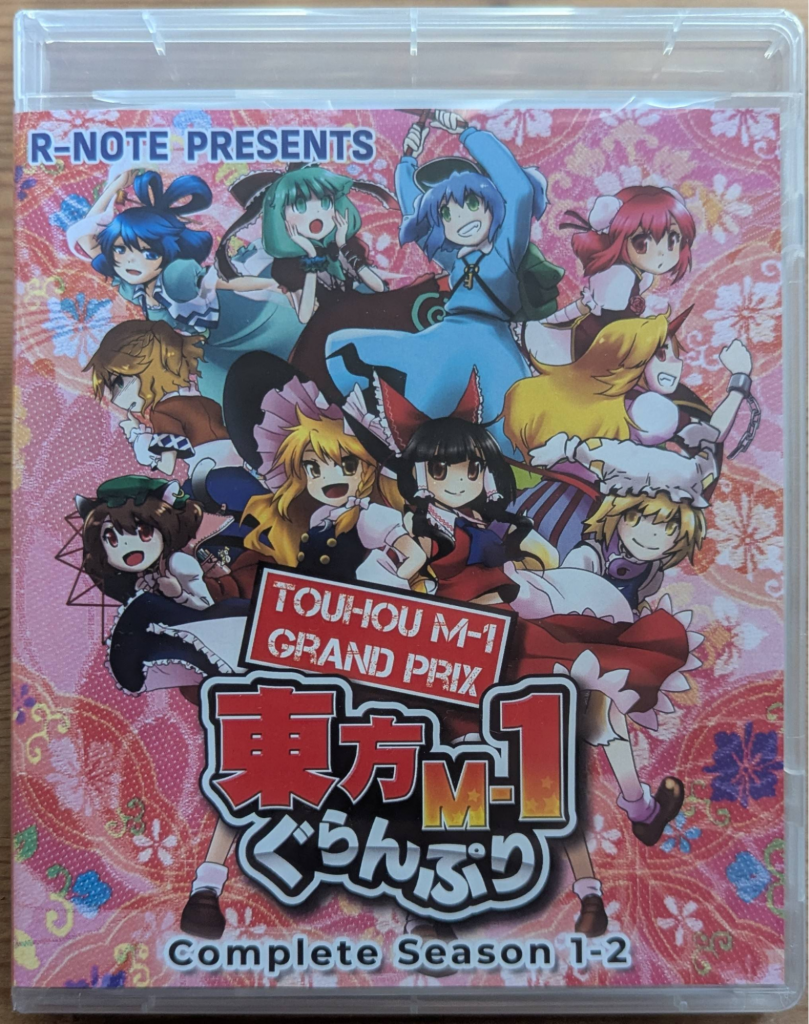
Please look forward to the release of the 20th Touhou M-1 Grand Prix on Dec. 31st!
Touhou M-1 Grand Prix is available for viewing on R-Note’s official YouTube channel and available for purchase on DLsite and Booth! You can check them out by clicking the links below!
Official R-Note YouTube channel : https://www.youtube.com/@あーるのーと公式
Touhou M-1 Grand Prix Playlist : https://www.youtube.com/playlist?list=PLrejIbHfXvbq_rwhM6nB8BoicNYOQMKJ1
R-Note Official Booth : https://rnote-en.booth.pm/
R-Note DLSite : R-NOTE(アールノート) サークルプロフィール | 作品一覧「DLsite 同人」
We also have a purchasing/viewing guide for those who are interested in the series!
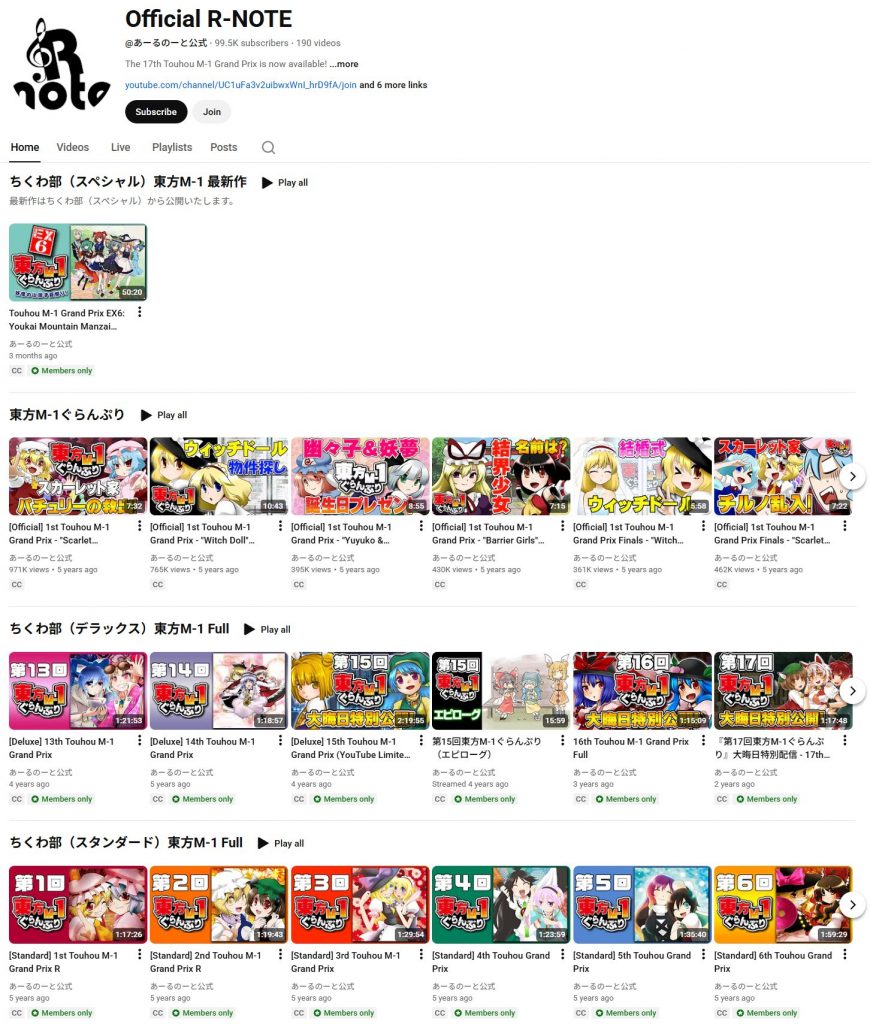
Viewing the series on YouTube
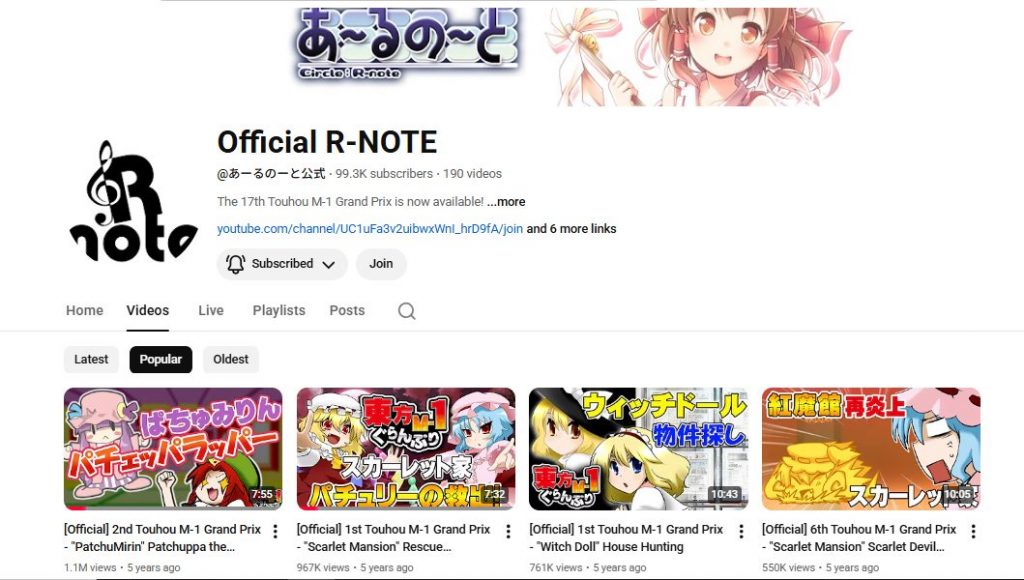
As mentioned previously, the the 1st-12th Grand Prix are available for viewing on YouTube, however, only in individual skit form. A single M-1 Grand Prix contains 7 skits (6 for the 1st and 2nd Grand Prix), along with the opening, in-between judging, commercial break, and the ending. In order to watch the full version of each Grand Prix, you can either purchase the individual series on booth, or become a member of the R-Note official YouTube channel.
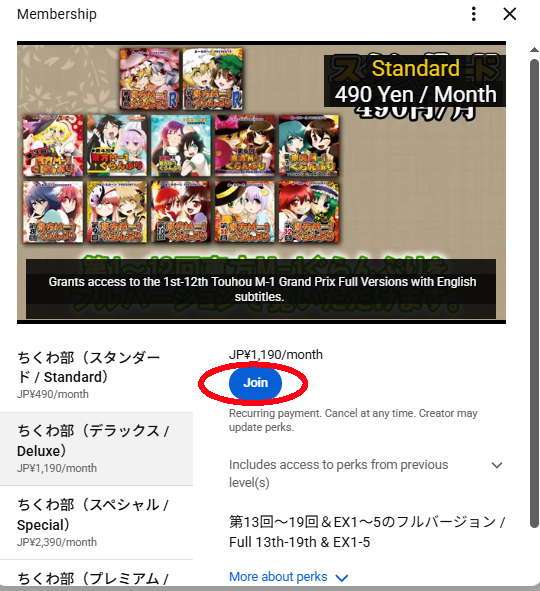
While there are 5 membership tiers for the channel, only 2 are relevant for English speakers, the standard and the deluxe membership. For 490 yen (less than $5), the standard membership gives you access to the full version of the first twelve M-1 Grand Prix available on YouTube, allowing you to also view the opening, in-between, and ending segments instead of only the skits.
Deluxe membership gives you access to every M-1 Grand Prix after the 12th one, extra bonus grand prix, as well as any future grand prix in R-Note’s yearly release. If you’re interested in seeing what comes after the 12th, but aren’t able to afford much, then I’d highly recommend getting this membership, as for only 1190 yen/month (less than $10), you get access to everything, with the ability to cancel at any time.
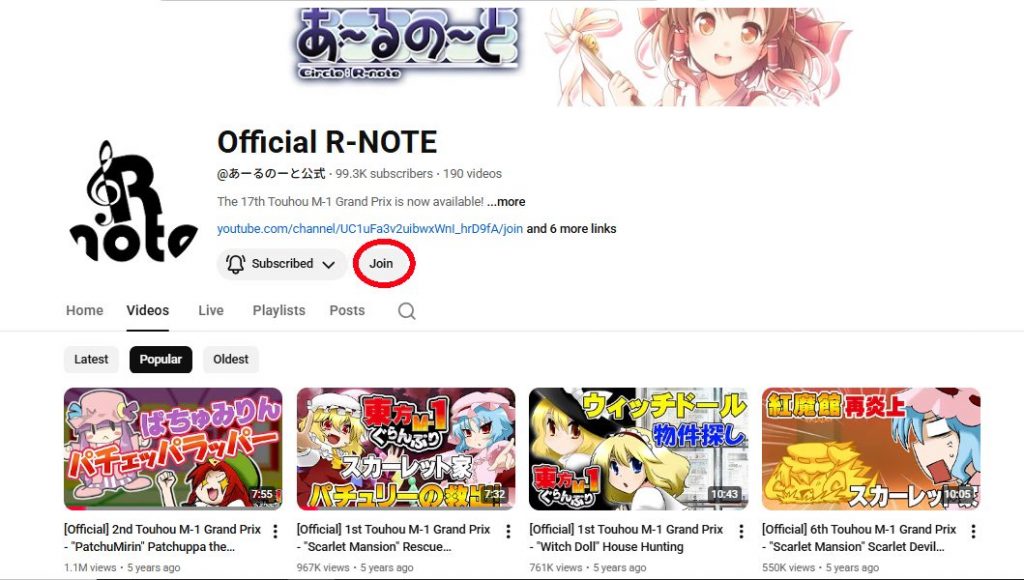
To join follow the steps bellow :
- go to the Official R-Note YouTube channel, click the “Join” button right next to the subscribe button.
- Choose which membership you’d like, standard or deluxe, then click “Join”.
- You’ll be asked to choose a payment option, choose whichever option is convenient for you (this will vary depending on which country you live in).
- Once you’ve setup your payment option, click “Buy”.
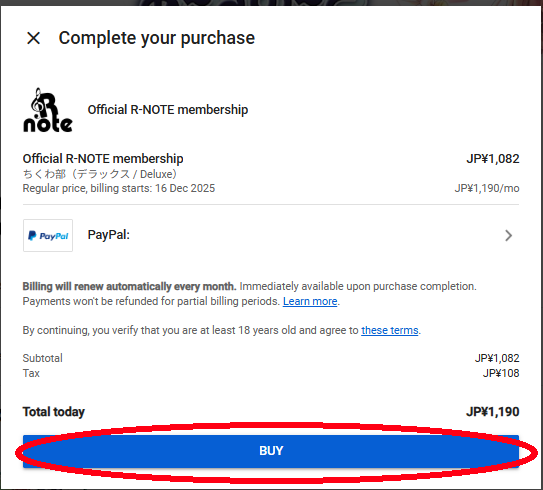
You will now have access to the members only playlist, containing the M-1 series after 12, as well as all the EX Grand Prix
Purchasing on DLsite
If you prefer to download the videos and keep them on your hard drive, the series is also available for purchase on DLsite!
Note that due to credit card processors terminating their support for the website, overseas audiences must perform their purchases in a roundabout way, by first purchasing in-store credits.
Here are the steps to purchase on DLsite.
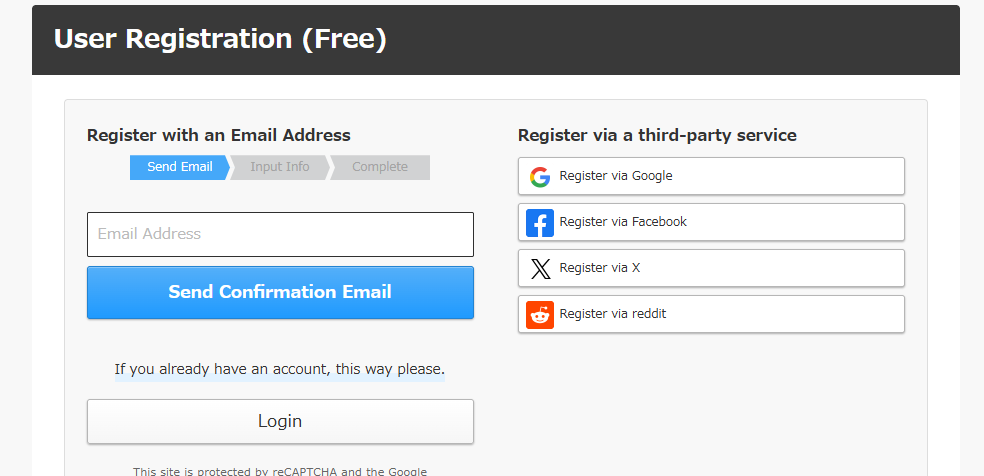
- Register for the site, you can make this easier by signing up with Google, Facebook, Twitter, or Reddit.
- Once you’ve made an account, access R-Note’s EN DLsite page by clicking the following link : https://www.dlsite.com/home/circle/profile/=/maker_id/RG01046022.html
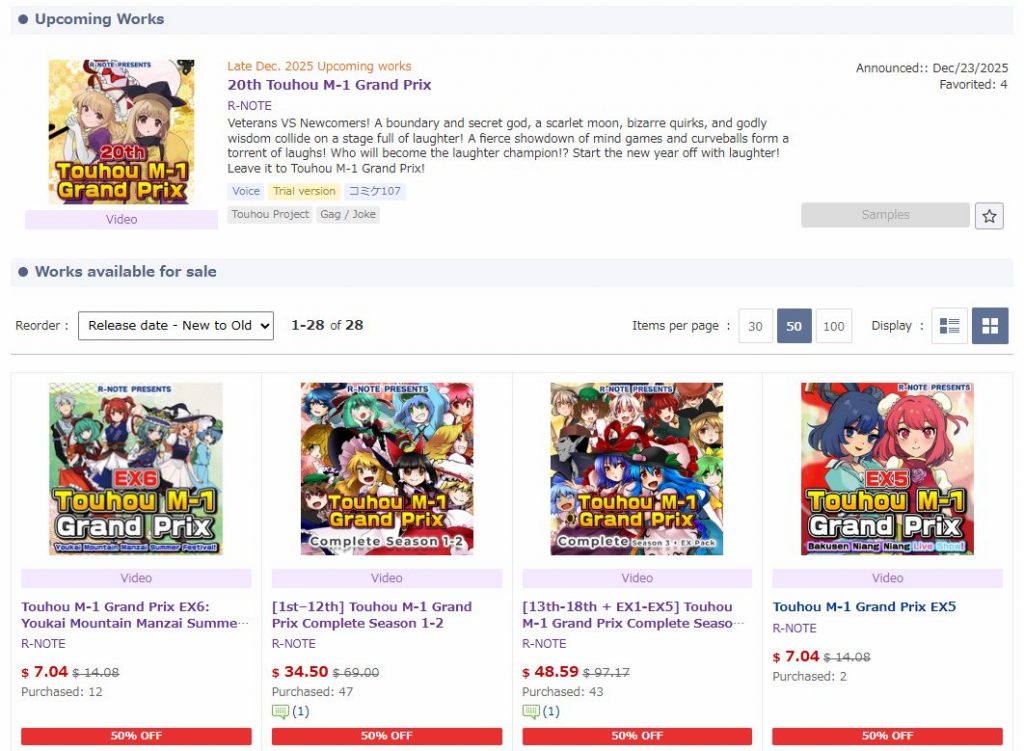
- Select the M-1 Grand Prix you wish to purchase
- Click the “Purchase Points” button.
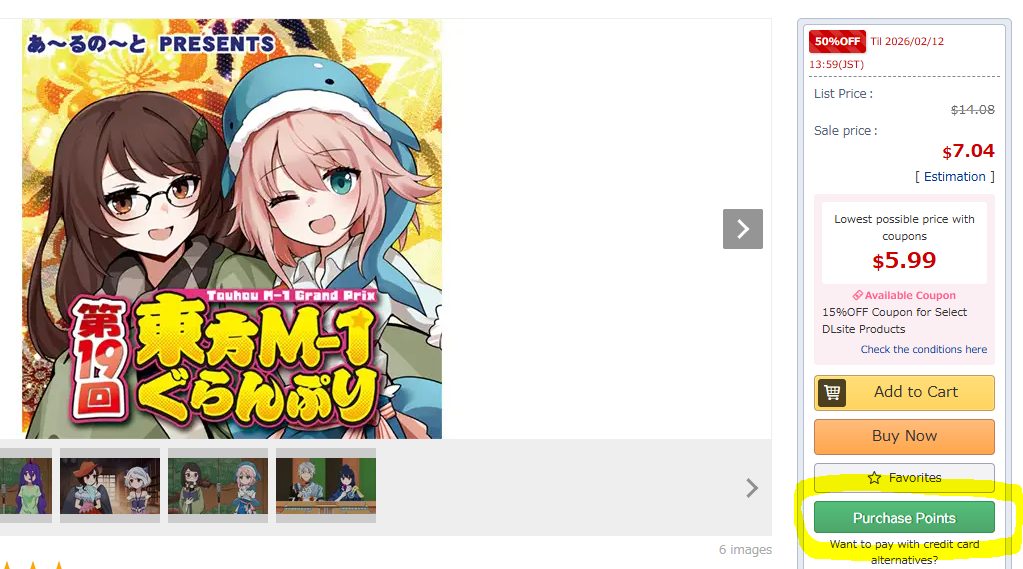
- Select your preferred method for purchasing points.
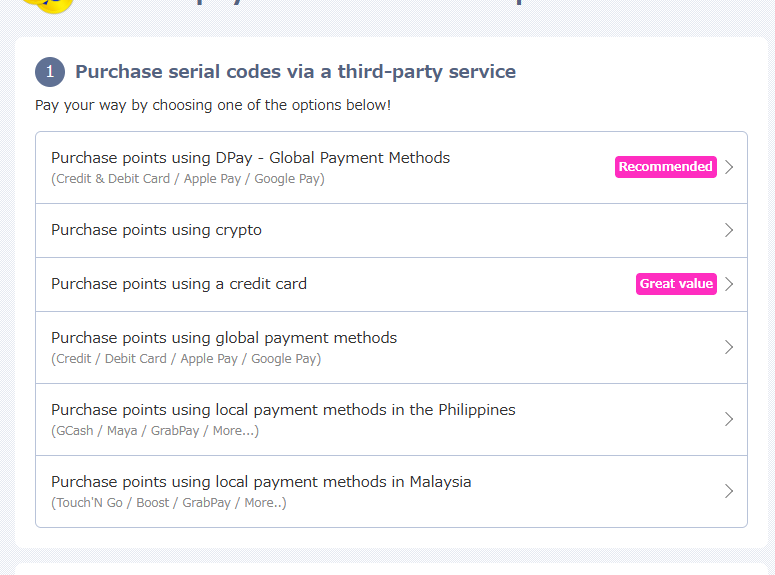
- Once you’ve purchased the points, follow the transaction until the end.
- Once the purchase is finished, you can download the item to your device.
Purchasing on Booth
Finally, the series is also available for purchase on Booth. Compared to DLSite, purchasing is easier, since they accept PayPal and international credit card. However, all the files are split into 1 GB chunks and must be combined before you can access them.
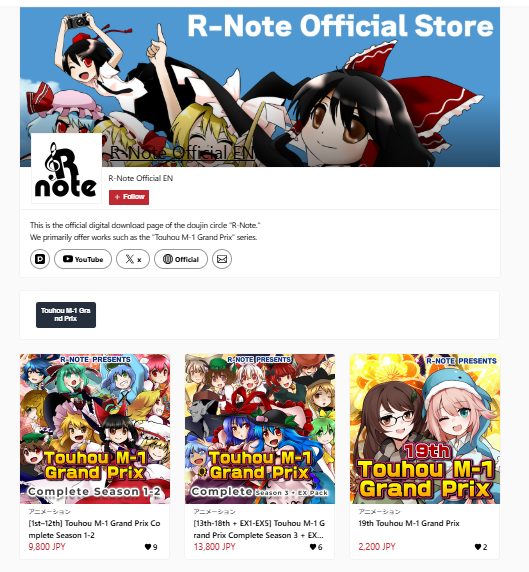
For those of you who’re interested in purchasing on Booth, but aren’t sure how to navigate the site, you can follow the instructions below :
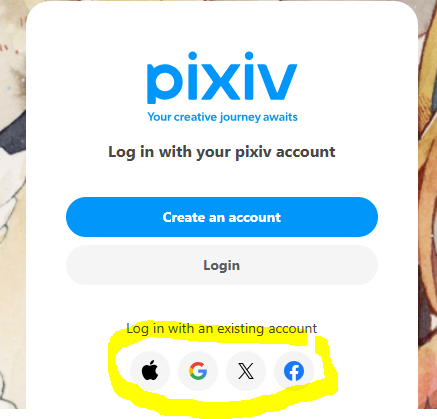
- Register for Pixiv, you can make this easier by signing up with Apple, Google, Twitter, or Facebook.
- Once you have an account, access R-Note’s official Booth by clicking the following link : https://rnote-en.booth.pm/items
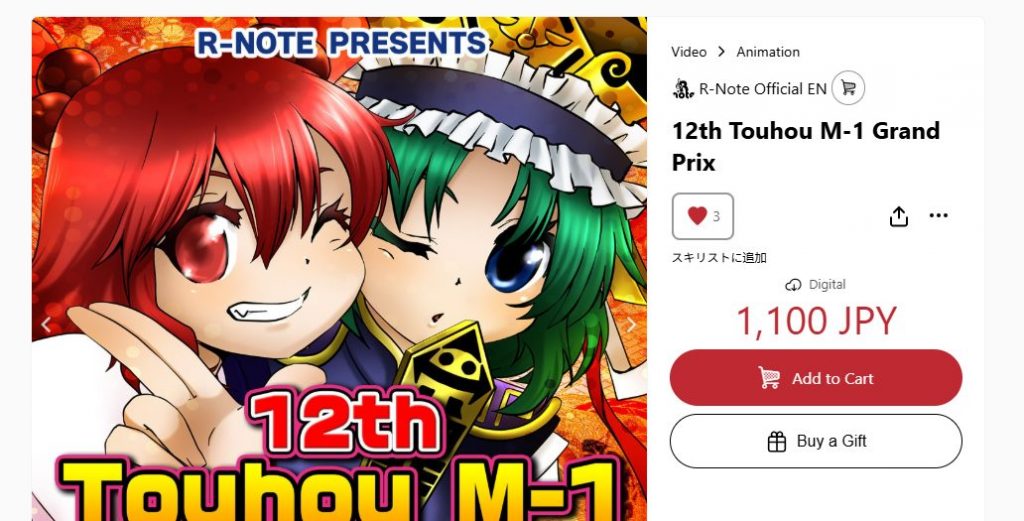
- Select the M-1 Grand Prix you wish to purchase
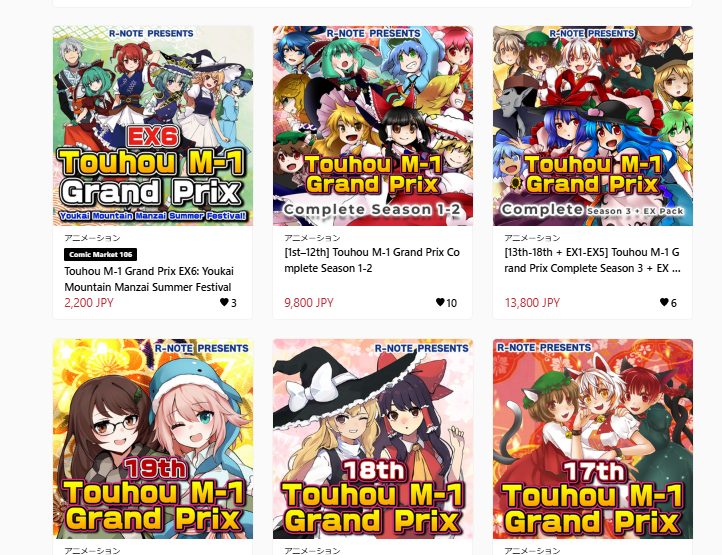
- Click “Add to Cart”, then click “checkout”.
- Confirm your login details.
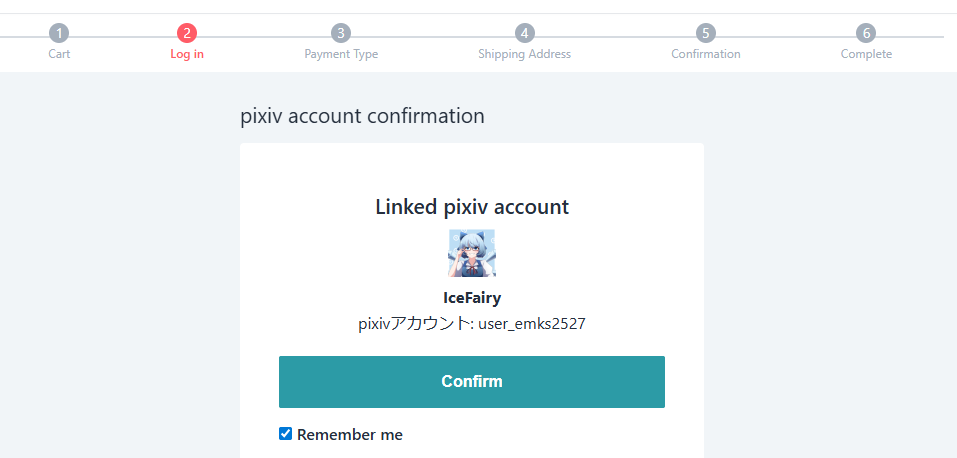
- Choose your payment options. Credit Card or PayPal are the most convenient to use.
- Once you’ve set up your preferred payment option, click confirm purchase.
- The purchase will be added to your account. You will be free to download it any time you want!
Interview with Touhou M-1 Grand Prix Translation Team Part 2 End